


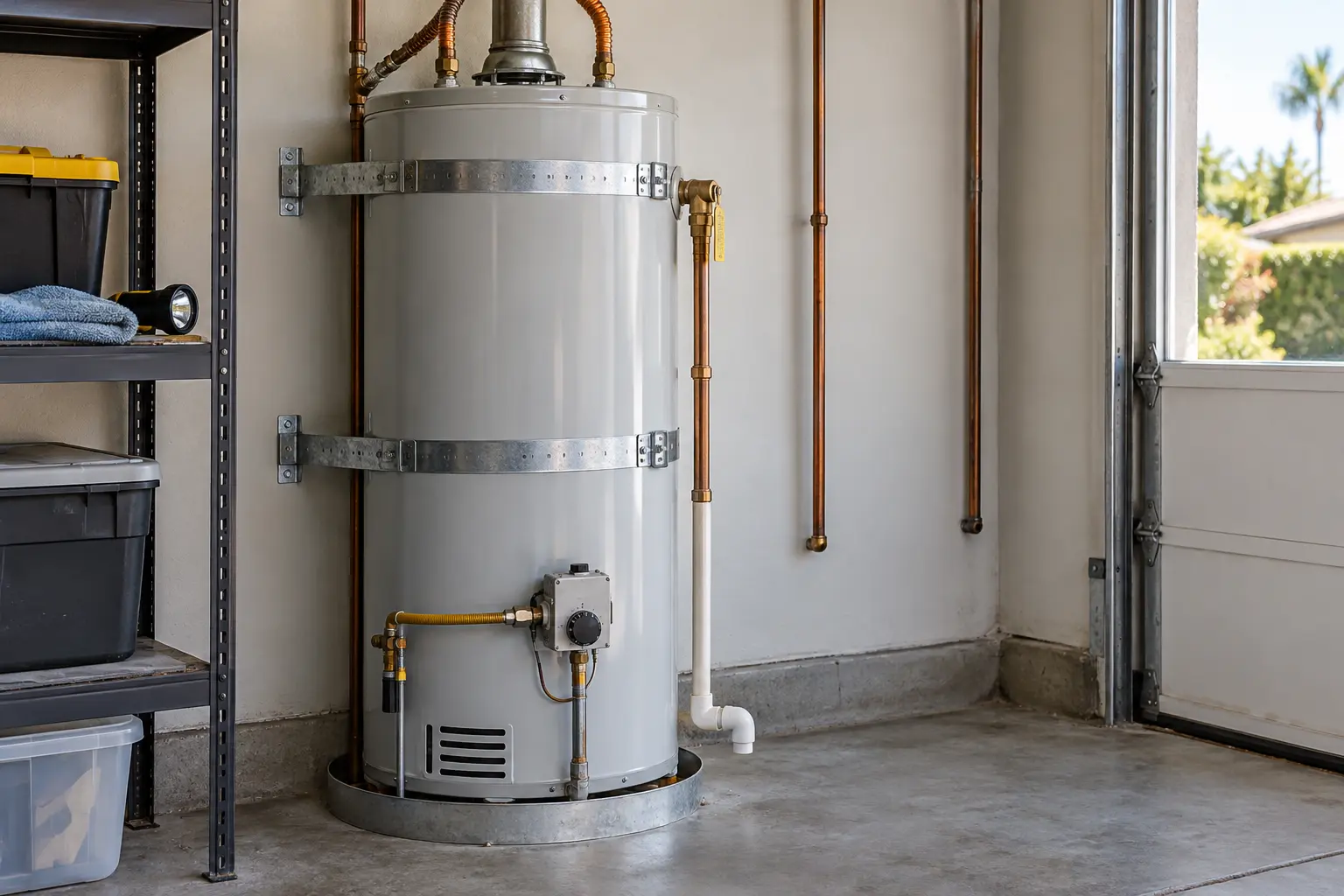

Water heater maintenance comes down to five checks a year: flush the tank, test the relief valve, inspect the anode rod, confirm the thermostat setting, and check that the straps are tight and the floor underneath is dry. Most take a few minutes. The flush is the one people skip, and it matters more where the groundwater runs hard, as it does across Santa Clara County. Below you’ll find the checklist, the steps for flushing a tank or a tankless heater, what a noisy heater is telling you, and how to shut one off safely.
Key Takeaways
- Five yearly checks cover most of it: flush, relief valve test, anode rod, thermostat at 120°F or lower, and strapping and leaks.
- Tank heaters need a flush at least once a year, and more often in hard water. Tankless heaters need descaling on the schedule in the manufacturer’s handbook.
- Rumbling or popping is a reason to flush sooner, not a reason to ignore the sound.
- To shut off an electric heater, flip its breaker. For a gas heater, turn the dial to off and close the gas valve at the heater.
- If you smell gas, leave and call 9-1-1 before you touch anything.
- California requires residential water heaters to be braced, anchored, or strapped against earthquakes.
On This Page
- Water Heater Maintenance Checklist: Five Checks Every Year
- How to Flush a Water Heater and a Tankless Water Heater
- Water Heater Making Noise? What the Sounds Mean
- How to Turn Off a Water Heater Safely
- Water Heater Maintenance FAQs
- Next Steps for Your Water Heater
Water Heater Maintenance Checklist: Five Checks Every Year
Do these five once a year, and write the date on the tank so you don’t have to remember. The table shows how often each one comes around and what you’re looking for.
| Check | How Often | What You’re Looking For |
|---|---|---|
| Flush the tank | At least once a year, more often in hard water | Sediment draining out, then water running clear |
| Test the relief valve | Once a year | Water discharges when you lift the lever, and the valve closes again |
| Inspect the anode rod | Once a year | A smooth rod about half an inch thick, with no long stretch of bare core wire |
| Check the thermostat | Once a year | A setting no higher than 120°F |
| Check straps and look for leaks | Once a year | Tight straps, and no moisture or rust at the base or fittings |
The relief valve and anode rod checks come from A. O. Smith’s maintenance guide. It says a professional should check the valve every five years, and that you should replace the rod if it’s deteriorated or shows several inches of exposed core wire. The same guide puts the thermostat at typically no higher than 120°F, and warns that a setting that’s too low can let bacteria grow.
Strapping isn’t optional here. State law says new, replacement, and existing residential water heaters must be braced, anchored, or strapped against earthquake motion, so a slack or missing strap is a repair, not a preference.
Annual checks tend to turn up small jobs, like a loose strap or a weeping fitting. Those fall under general household fixes and repairs. Our page on gas, electric, and tankless water heaters lists flushing, anode rod inspection, and relief valve checks as maintenance work, along with repair and replacement.
How to Flush a Water Heater and a Tankless Water Heater
To flush a water heater, you shut off the energy source and the cold water, drain the tank through its drain valve, and refill it. It takes a garden hose and some patience. Read the shutoff steps in the section below before you start, and check your manual for the order your model wants.
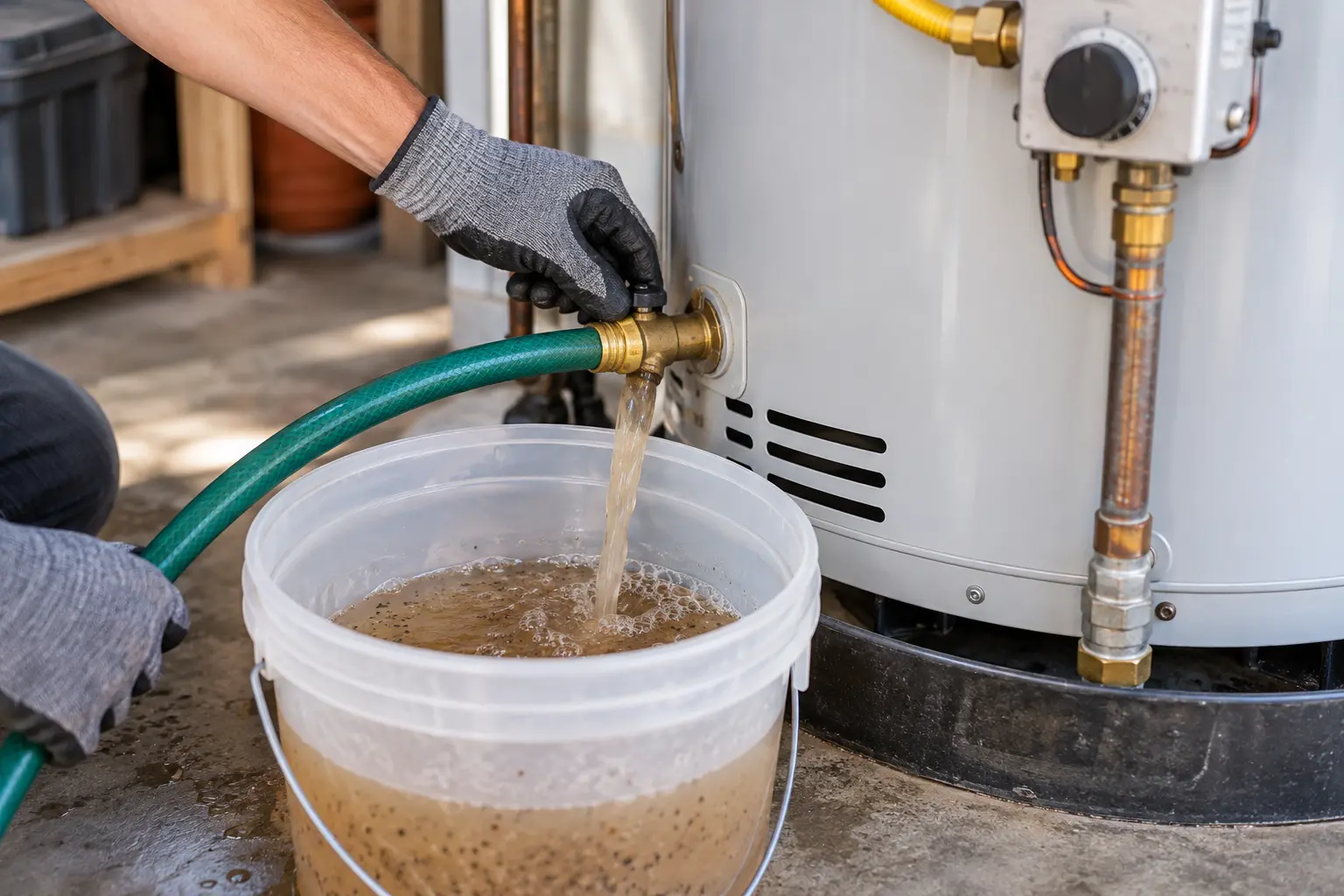
How to Flush a Tank Water Heater
- Turn off the power at the breaker, or turn a gas heater’s dial to off. Let the tank cool for a few hours, or overnight, so the water isn’t scalding.
- Close the cold water valve at the top of the tank.
- Attach a garden hose to the drain valve near the bottom and run it to a floor drain or outside, away from plants.
- Open a hot tap somewhere in the house so air can enter, then open the drain valve and let the tank empty.
- Check the water coming out. Brown, cloudy, or gritty water means sediment. When the tank is empty, open the cold supply briefly to stir up what’s left, then drain again until the water runs clear.
- Close the drain valve, remove the hose, and open the cold supply to refill. Leave the hot tap open until water runs steadily, then close it.
- Restore power or relight the pilot only once the tank is full. An electric element running in an empty tank can burn out.
If a valve sticks or won’t close after you open it, stop and call a technician. An old tank with no maintenance history is the usual place this goes wrong.
Santa Clara County groundwater is hard, so a yearly flush is the minimum here. If you still pull out heavy scale every time, a softener or whole-house filter treats the water before it reaches the tank. Our water filtration and purification system installation page covers water softeners, whole-house filters, and ion exchange systems.
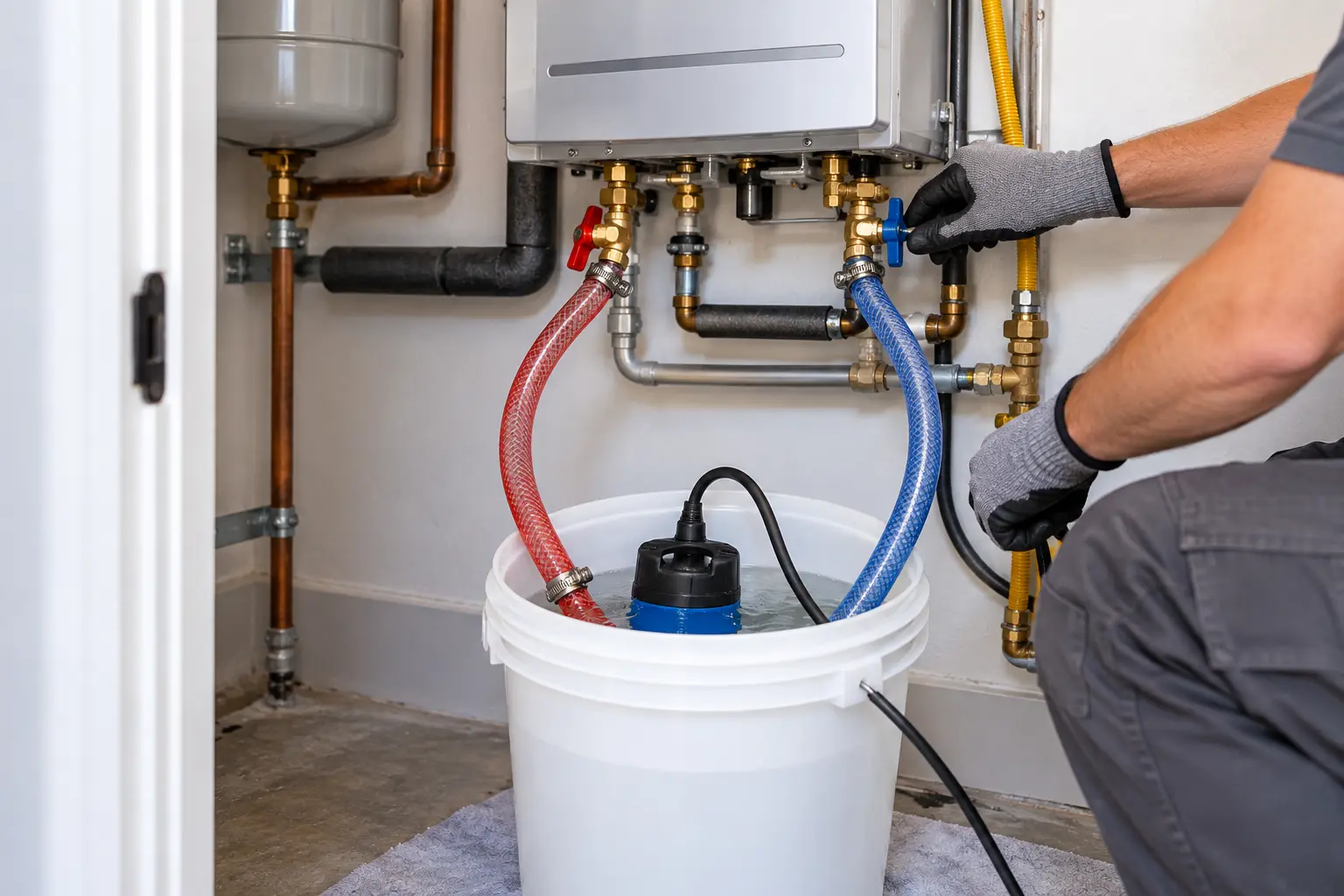
How to Flush a Tankless Water Heater
A tankless heater has no tank to drain, but it scales up inside. A. O. Smith says flushing isn’t needed on a tankless unit, but many models require descaling, and the schedule is in the manufacturer’s handbook. In practice that’s the tankless flush: you circulate descaling solution through the heat exchanger, then rinse it out.
- Turn off the power or gas, then close the water supply valves.
- Connect hoses to the hot and cold service valves, and run them through a small pump and a bucket of descaling solution your manufacturer approves.
- Circulate the solution for the time your handbook specifies.
- Drain the solution, flush the unit with clean water, then close the service valves, reopen the supply valves, and restore power or gas.
If you can’t find service valves, stop there. Fitting them is a plumbing job, and a gas tankless unit also has venting and gas connections that belong with a technician.
Water Heater Making Noise? What the Sounds Mean
A water heater making noise is usually asking for a flush. Energy Trust of Oregon lists unusual rumbling or popping as a reason to drain and flush sooner than your usual schedule, and says flushing removes sediment that can damage the tank or heating equipment.
| What You Hear | What It Often Means | What to Do |
|---|---|---|
| Rumbling or popping from the tank | Sediment on the bottom of the tank | Flush it now, then listen again |
| Knocking or banging in the pipes | A plumbing problem rather than the heater | Check pressure and water color, and have the water line looked at if they’re off |
| Any noise with water at the base | A leak | Shut off the heater and its water supply, then call a technician |
| Any noise with a gas smell | A gas leak | Leave and call 9-1-1 before touching anything |
Noisy pipes, low pressure, and discolored water are also warning signs on our water line repair and replacement page, where they point to a corroded or clogged line instead of the heater. If the flush doesn’t quiet the tank, the sediment may have hardened, and that’s a job for a technician.
How to Turn Off a Water Heater Safely
How you turn off a water heater depends on what powers it.
- For an electric heater, flip its breaker in the main panel.
- For a gas heater, turn the thermostat dial to off, which puts out the pilot, then move the gas supply valve so its handle sits at a right angle to the gas line.
- For either type, close the cold water valve above the tank before you drain or flush it.
The valve at the heater is for routine work, and it stops gas to that appliance only. The meter valve is for emergencies. If you smell gas, leave the area and call 9-1-1, and stay away from phones, light switches, and matches until you’re at a safe distance. PG&E also says that once gas has been shut off after a leak, you shouldn’t turn it back on yourself. A PG&E representative or another qualified professional should do a safety check first.
Water Heater Maintenance FAQs
How Often Should I Flush My Water Heater?
Flush a tank water heater at least once a year, and more often if you have hard water. Santa Clara County groundwater averages over 250 mg/L of hardness, which is in the very hard range. Rumbling or popping noises are a sign to flush sooner than your usual schedule.
How Do You Flush a Tankless Water Heater?
Turn off the power or gas and close the water supply, connect hoses to the service valves, and circulate a manufacturer-approved descaling solution for the time your handbook specifies. Then flush with clean water and restore power. If there are no service valves, a technician should add them first.
Why Is My Water Heater Making Noise?
Rumbling or popping usually points to sediment on the bottom of the tank, and a flush is the first fix. Knocking in the pipes can come from the plumbing instead. Water at the base means a leak, so shut the heater off and call a technician. A gas smell means leave and call 9-1-1.
How Do I Turn Off a Water Heater?
Flip the breaker for an electric heater. For a gas heater, turn the thermostat dial to off and close the gas supply valve so the handle sits at a right angle to the line. Close the cold water valve above the tank as well if you’re draining or flushing it.
How Much Does Water Heater Maintenance Cost?
A DIY flush costs little beyond a hose and an hour, since the yearly checks use tools most homes already have. A technician visit varies with the heater type, the access, and whether it’s gas, electric, or tankless, so ask whether the price is hourly or fixed and what it includes.
Do I Need a Licensed Contractor for Water Heater Work in California?
The yearly checks are homeowner jobs. Replacing the heater, or any work on the gas line or electrical supply, is best left to a licensed contractor, and your city’s building department can tell you when a permit applies. California also requires residential water heaters to be strapped against earthquakes.
Next Steps for Your Water Heater
Water heater maintenance is mostly small, repeatable work, and one flush a year does most of it. The calls worth making are the ones past the checklist: a gas connection, a tank that leaks, or an old heater with no maintenance history.
If you’d like a technician to look at yours, schedule a visit with Proper Hour Home Service. We’re a licensed contractor, CSLB #1131330, serving homeowners across the South Bay and the Peninsula.