


Most carpentry services a South Bay homeowner needs take less than three hours: a door that drags on the frame, a cabinet door hanging crooked, a drawer that drops off its track, a stretch of baseboard the dog got to. None of that needs a custom shop. It needs someone with shims, a plane, the right screws and the patience to find out why the door stopped closing. This guide sorts carpentry jobs into the ones a handyman finishes in one visit, the ones that call for a finish carpenter, and the point where California law requires a licensed contractor, so you book the right person the first time.
Key Takeaways
- Door, cabinet, drawer, closet, trim and shelving repairs are carpentry services a handyman can usually finish in a single visit.
- A finish carpenter builds and fits new millwork: built-ins, cabinet runs, crown molding and stair parts. California licenses that work under the C-6 finish carpentry classification.
- An unlicensed handyman in California can only take jobs under $1,000 in total that need no building permit. Anything larger needs a licensed contractor.
- Proper Hour Home Service is a licensed contractor, CSLB #1131330, and takes the whole repair list in one booking, carpentry items and everything else on it.
- Appointments run seven days a week, 8 a.m. to 8 p.m., across San Jose, Santa Clara, Los Gatos, Fremont, San Mateo and San Bruno.
On This Page
- Carpentry Services a Handyman Finishes in One Visit
- Handyman vs Carpenter: Where the Work Splits
- When a Finish Carpenter or Licensed Contractor Takes Over in California
- Why Doors, Cabinets and Trim Fail in Older South Bay Homes
- Frequently Asked Questions
- Book Carpentry Services in San Jose and the South Bay

Carpentry Services a Handyman Finishes in One Visit
Carpentry services, in a handyman’s terms, are the repair and installation of the wood parts of a house you touch every day: doors, drawers, cabinets, trim and shelves.
That’s also where most of the small jobs sit. The ones Proper Hour Home Service customers write about most are carpentry, even when nobody calls it that: drawer tracks that finally slide again, garage cabinets taken down and hung back up, a set of sliding closet doors installed with the old ones hauled away, a front door realigned so it latches. A typical list looks like this:
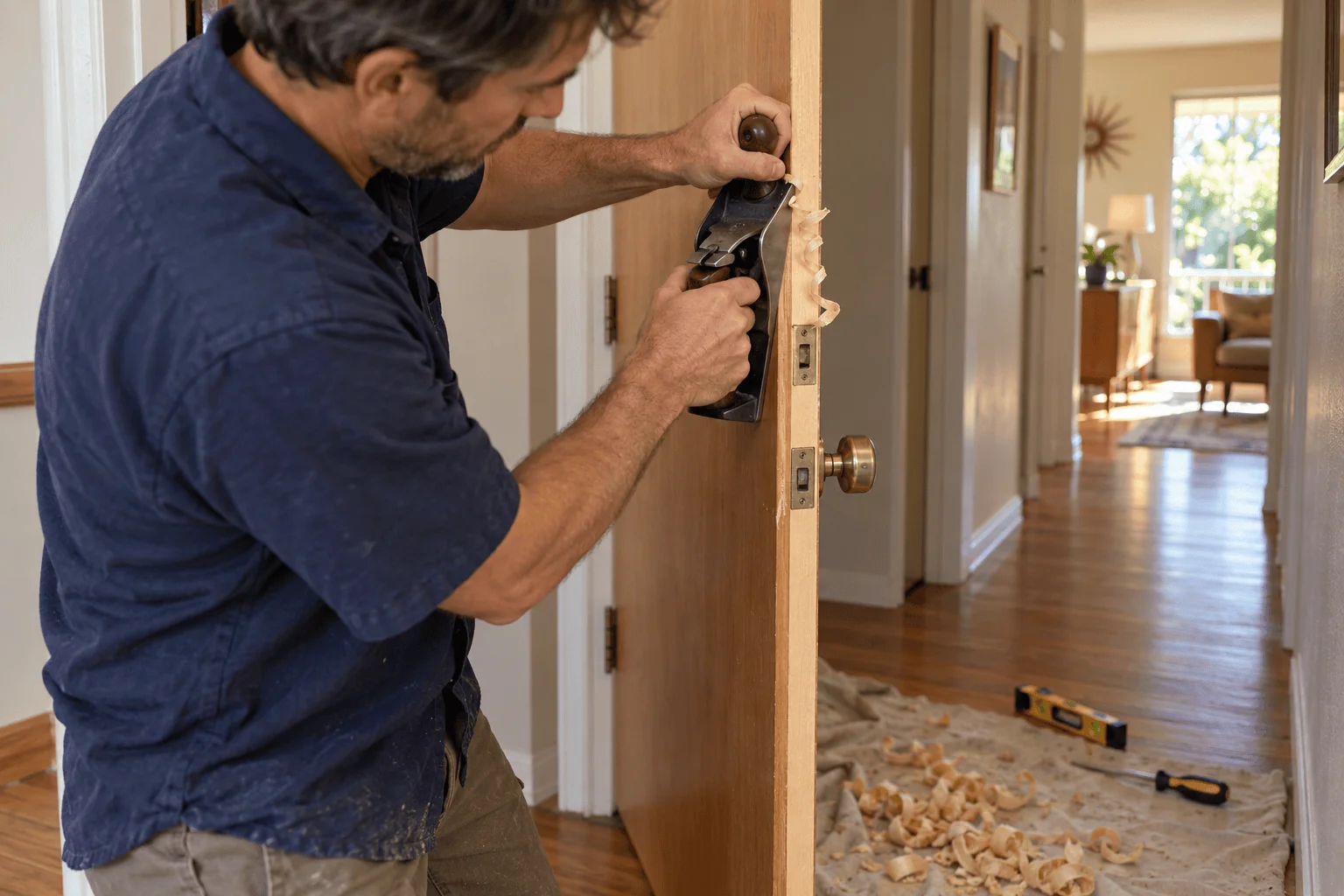
- A door that sticks, won’t latch or swings open on its own
- Cabinet doors that sag or don’t close flush, stripped hinge screws, broken drawer slides
- Closet doors off their track, or bifolds that jam halfway
- Split or water-stained baseboard, loose door casing, a gap along the floor
- Shelves, curtain rods and wall-mounted cabinets that need to go into studs, not drywall
Bring all of it. The general household fixes and repairs service covers these items alongside the faucet and the drywall patch, so they don’t need three separate appointments. Small, awkward jobs are the work Proper Hour Home Service’s handyman team was built around, and two hours is usually enough to clear most of a list like this.

Handyman vs Carpenter: Where the Work Splits
The Bureau of Labor Statistics describes carpenters as the trade that builds, repairs and installs the wood framework and structure of a building, from walls and floors to door frames and molding. That’s a wide trade. A handyman covers the repair end of it; a carpenter covers the building end.
Here’s how the carpenter vs handyman split usually falls on a real list:
| Job | Handyman | Carpenter or contractor |
| Planing or rehanging a sticking door, new hinges or strike plate | Yes | |
| Cabinet doors realigned, hinges and drawer slides replaced | Yes | |
| Sliding or bifold closet doors reset or replaced | Yes | |
| A few lengths of baseboard or door casing replaced | Yes | |
| Shelves, curtain rods, furniture assembly | Yes | |
| Crown molding or new trim through a whole floor | Finish carpenter | |
| Built-ins, bookcases, window seats, a new cabinet run | Finish carpenter | |
| Rotted framing, sagging joists, removing or moving a wall | Licensed contractor, with a permit |
The dividing line is new work versus repair. If the job is making something that exists work again, call a handyman. If it’s making something that doesn’t exist yet, especially anything cut to fit a whole room, that’s a finish carpenter. If it involves the structure holding the house up, it’s a licensed contractor with a permit.
When a Finish Carpenter or Licensed Contractor Takes Over in California
California law draws a hard number under all of this. Business and Professions Code section 7048, as amended by AB 2622, lets unlicensed workers take a job only if labor, materials and everything else total less than $1,000 and the work needs no building permit. That’s been the rule since January 1, 2025. A new crown molding job through a living room, dining room and hall clears $1,000 quickly.
Above that line, finish carpentry is a licensed trade. CSLB’s C-6 classification covers cabinets, sashes, doors, trim and nonbearing partitions, both building them and installing them. Framing and rough carpentry sit in a separate class, C-5.
Before you hire anyone for a job that size, look up the license number on CSLB’s website and check which classifications it carries. That goes for Proper Hour Home Service too: we’re a licensed contractor, CSLB #1131330, and the record is public. For the fuller picture of where handyman work ends, read when California requires a licensed contractor.
Why Doors, Cabinets and Trim Fail in Older South Bay Homes
Most houses across San Jose, Santa Clara and Los Gatos went up between the 1950s and the 1990s, and their carpentry problems are predictable. Houses settle, and a door hung true in 1965 ends up rubbing at the top corner. Hinge screws strip out of soft jambs after decades of use. Cabinets from the 1970s and 1980s often have particleboard drawer boxes and slides that were never meant to last this long.
Moisture is the other half. Exterior doors and wood trim swell through the wet winter months and shrink back by summer, which is why a door that sticks in January may close fine in July. Planing it in the middle of winter can leave a gap later, so the technician checks where it’s rubbing and why before taking wood off.
- Take a photo of each item and measure anything you want replaced, such as a baseboard run or a closet opening.
- Say if you’ve already bought the part. A slide or hinge that doesn’t match the cabinet costs a second trip.
- Pair fall carpentry with the rest of the seasonal home upkeep checklist, since sealing doors and windows before the rains fits on the same visit.
If you’re still choosing who to call, our guide to finding a trusted handyman walks through the license check, reviews and what a fair quote looks like.
Frequently Asked Questions
How much do carpentry services cost in San Jose?
Small carpentry services in San Jose are usually billed by the hour, and a two-hour minimum is common in this market, so a sticking door and five other small jobs can cost about the same as the door alone. Door or cabinet condition, who supplies the hardware, and how many items batch into one visit move the price most.
Anything that totals $1,000 or more, or needs a permit, is licensed contractor work under California law and gets its own estimate.
Is a carpenter the same as a handyman?
No. A handyman repairs and adjusts what’s already in the house, across several trades in one visit. A carpenter builds and installs new woodwork, from framing to finish trim and cabinets. For a sticking door or a broken drawer slide, a handyman is the right call. For custom built-ins or new trim through a whole floor, hire a finish carpenter.
Do I need a licensed contractor for finish carpentry in California?
You do if the job totals $1,000 or more in labor and materials, or if it needs a building permit. Below that, California’s minor work exemption lets an unlicensed handyman do the work. Finish carpentry above the threshold falls under CSLB’s C-6 license class, so check the contractor’s classification on the CSLB website before you sign.
How soon can I get a carpenter near me in the South Bay?
Proper Hour Home Service books carpentry repairs seven days a week, 8 a.m. to 8 p.m., in San Jose, Santa Clara, Los Gatos, Fremont, San Mateo and San Bruno, with same-day visits when a slot is open. For custom finish carpentry, expect a measuring visit first, because the pieces are cut to fit your rooms.
Book Carpentry Services in San Jose and the South Bay
Start with the list. If it’s doors, drawers, cabinets and a few lengths of trim, that’s a single handyman visit. If it’s new millwork through a whole room, you want a finish carpenter and a licensed estimate. Either way, send the photos and book a technician for a day that suits you, or use the call button at the top of the page.