


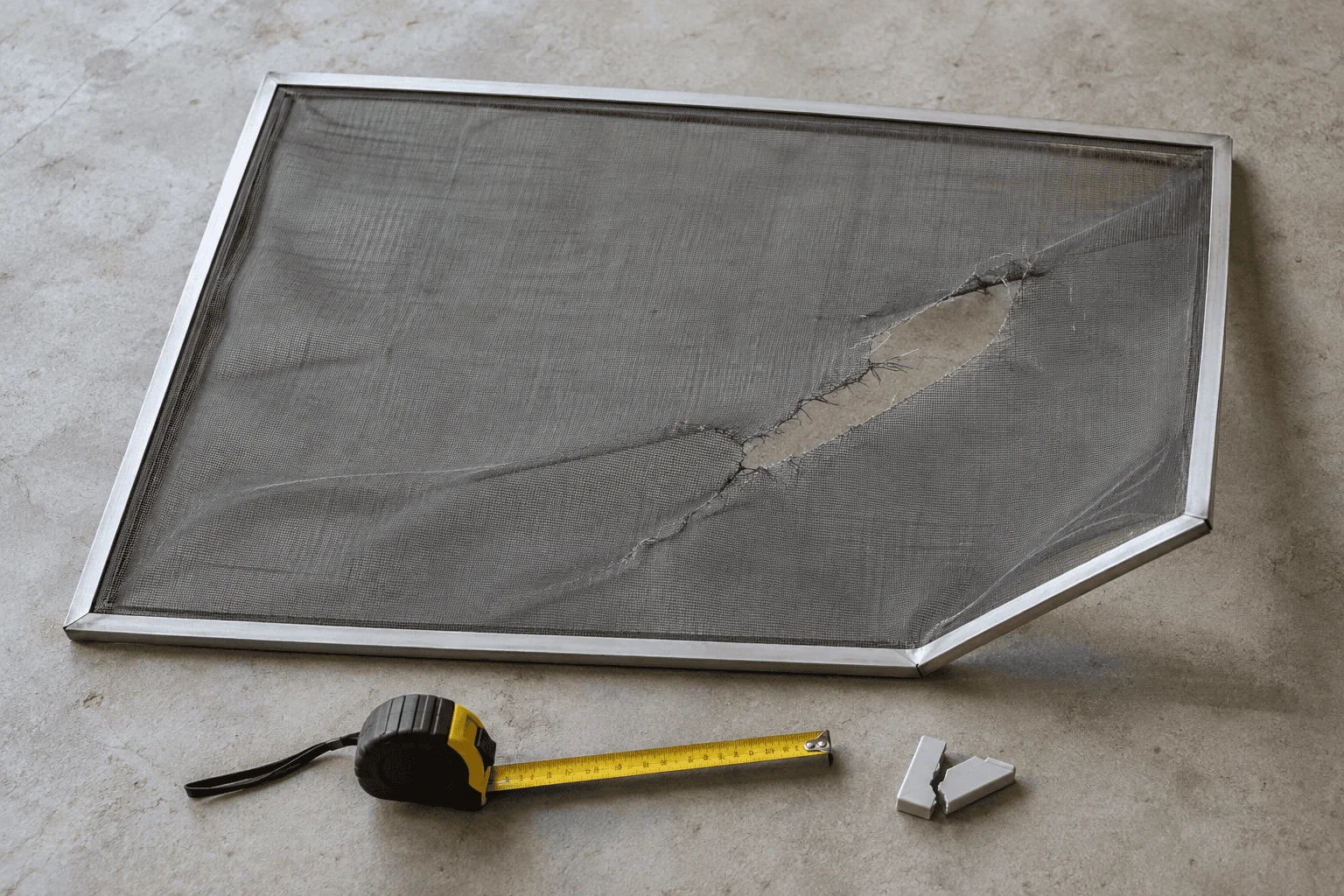

Window screen replacement usually starts with the wrong question. People ask what a new screen costs, when the real question is whether the old frame is worth keeping. A torn mesh in a straight frame is a quick rescreen: new mesh, new spline, done. A frame that’s bent, cracked at a corner or no longer fits the window needs replacing, and new mesh in a bad frame just leaves gaps the bugs find by August. This guide covers how to tell which one you have, which mesh to choose, and what to sort out before you book.
Key Takeaways
- Rescreening means new mesh and spline in the existing frame. Frame replacement means a new frame built to the window opening.
- If the frame lies flat, the corners are tight and it still fits the window, rescreen it. If it’s bent, cracked or loose in the opening, replace the frame.
- Fiberglass mesh suits most windows. Aluminum holds its tension; vinyl-coated polyester stands up to pets.
- Screens keep insects out. They are not built to stop a child from falling, so upper-floor windows need stops or guards.
- Measure the window opening, not the old screen, and bring every damaged screen to the same visit.
On This Page
- Window Screen Replacement Starts With the Frame
- Fiberglass, Aluminum or Pet Screen: Picking the Mesh
- What Screens Do and What They Don’t
- Getting Window Screens Fixed in a South Bay Home
- Frequently Asked Questions
- Book Window Screen Repair in San Jose and the South Bay
Window Screen Replacement Starts With the Frame
Window screen replacement covers two different jobs: rescreening, which puts new mesh and spline into the frame you already have, and frame replacement, which swaps the whole screen for a new one sized to the opening.
Take the screen out and lay it on a flat floor. Then run through this:
- Does it lie flat, with all four corners touching the floor? A twisted frame won’t seal against the window.
- Are the corner keys tight? Cracked or loose plastic corners let the frame rack out of square.
- Is the spline channel intact all the way round? A crushed channel won’t hold new spline.
- Does it still fit? If it has to be forced in, or falls out on its own, the frame is the problem.
- Are the tension springs, pull tabs and clips still there? These are cheap to replace, but only on a frame worth keeping.
Pass all five and it’s a rescreen. Fail the first three and you’re buying a frame. The mistake to avoid is paying for new mesh in a frame that’s already bent, because the tension from fresh mesh pulls a weak frame further out of shape.

Fiberglass, Aluminum or Pet Screen: Picking the Mesh
Mesh is the other decision, and it matters more than people expect. Phifer’s screen specifications describe fiberglass as the affordable everyday choice, aluminum as rust-proof and sag-proof, and vinyl-coated polyester as the tear- and puncture-resistant option.
| Mesh | Best for | Watch for |
| Fiberglass | Most windows; the standard choice and the easiest to install | Tears more easily than metal if something pushes through it |
| Aluminum | Screens that need to stay taut on a larger opening | Creases and dents if it’s pressed or bumped |
| Vinyl-coated polyester (pet screen) | Low windows and slider screens a dog or cat can reach | Heavier weave, so slightly less view and airflow |
For most windows, standard gray or charcoal fiberglass is the right answer. Charcoal is a little easier to see through from inside. Pet screen earns its cost only where a pet actually reaches, so put it on the low bedroom window and the slider, not on every screen in the house.
What Screens Do and What They Don’t
A screen has one job, and it does it well. CDC mosquito prevention guidance lists using, installing or repairing window and door screens among the ways to keep mosquitoes out of the house. A screen with a thumb-sized tear does almost nothing, which is why a hole is worth fixing the week it appears, not at the end of summer.
What a screen doesn’t do is hold weight. CPSC’s childproofing guide is plain that window screens are not effective at keeping children from falling out of windows, and recommends window guards instead. On any upper-floor window in a home with young children, add a window stop or a guard that an adult can open quickly, and move beds and furniture away from the sill.
It’s a good moment to check the window itself. A sash that won’t lock, a slider that jumps its track or a crank that spins without closing are the reasons screens get pushed out or bent in the first place.

Getting Window Screens Fixed in a South Bay Home
Across San Jose, Santa Clara and Los Gatos, a lot of homes built between the 1950s and the 1990s still have their original aluminum-frame screens. After 30 or 60 years of sun, the corner keys go brittle and the frames lose their square. Screens also go missing: pulled off for exterior painting, stacked in the garage and never put back.
Before you book, do three things:
- Count every screen, including the missing ones and the sliding patio screen. Several screens on one visit costs far less per screen than one at a time.
- Measure the window opening where the screen sits, width then height, to the nearest sixteenth of an inch. A bent old screen gives you the wrong size.
- Photograph each damaged screen and the window it came from, including the clips or spring holes on the frame.
Screens rarely fail alone. If the window sticks or won’t latch, get it looked at on the same visit through window repair and adjustment. A sliding door that drags or a loose handle can go on the same list of general household fixes, and screens are also a natural item on a seasonal home upkeep checklist, since spring is when most people open the windows again.
Frequently Asked Questions
How much does window screen replacement cost?
Window screen replacement cost depends mostly on whether the frame is reusable. Rescreening an existing frame costs less than having a new frame made, and fiberglass mesh costs less than aluminum or pet screen. Screen size and how many screens you do at once move the price too, since several screens on one visit share the trip.
Can I replace a window screen myself?
Yes, if the frame is sound. Rescreening takes new mesh, new spline in the right diameter, a spline roller and a utility knife. The hard part is keeping the mesh tight without bowing the frame inward. If the frame is bent or the corners are cracked, a DIY rescreen won’t fix the fit, and the frame needs replacing instead.
When should a window screen frame be replaced instead of rescreened?
Replace the frame when it’s bent or twisted, when a corner key is cracked, when the spline channel is crushed, or when the screen no longer sits snugly in the window. New mesh can’t correct any of those, and tightening fresh mesh in a weak frame tends to pull it further out of shape.
Is fiberglass or aluminum window screen better?
Fiberglass is the better default for most homes. It’s the standard mesh, it’s easy to install tight, and it won’t crease or dent. Aluminum holds its tension well on larger screens but creases if it’s pressed. For windows and doors that pets reach, vinyl-coated pet screen outlasts both.
Book Window Screen Repair in San Jose and the South Bay
Pull the screens, run the flat-floor test, and count what you’ve got. Good frames get new mesh; bent ones get replaced. Send the photos and measurements and schedule a visit for a day that works, or use the call button at the top of the page, and have the window checked while the screens are out.

